
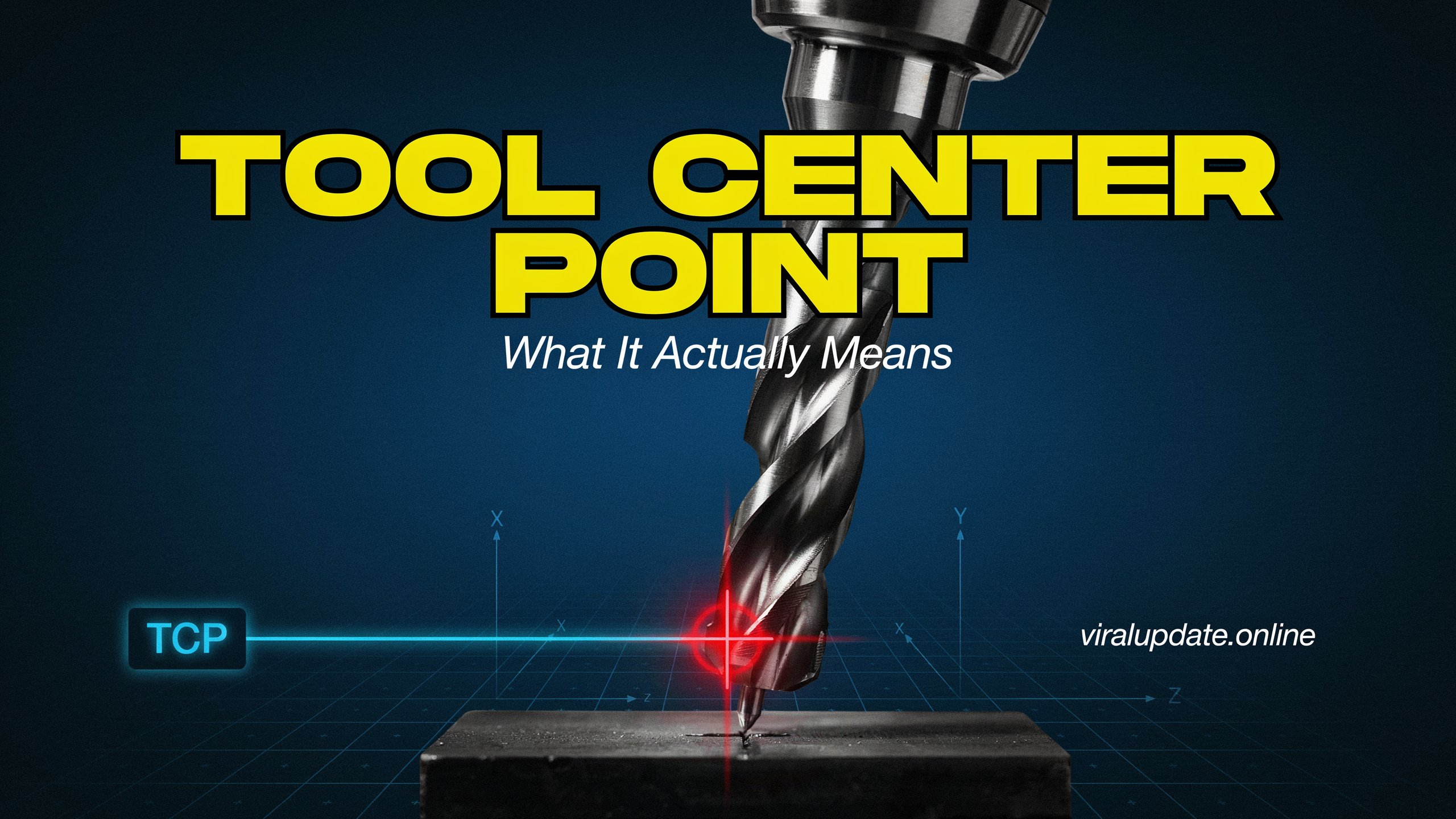
Tool Center Point (TCP) – the backbone of CNC machining and industrial robotics – is a crucial concept you should understand, no matter if you’re a robot programmer, CNC machine operator, or just learning about automation. Grasping the Tool Center Point definition will seriously boost your accuracy and efficiency, even with very advanced machines.
To put it in simple terms, the Tool Center Point is the precise spot on a tool where the actual work gets done. Machines and robots use this point as a reference point when figuring out their movements. Without a properly defined TCP, even machines that are pretty slick can still produce sloppy results.
This guide will cover what Tool Center Point is all about, how it works, where it is used, and why it matters in real-world applications.
What Is Tool Center Point?
The Tool Center Point, or TCP for short, is the exact point at the end of a tool that does the actual work. It acts as the reference point that machines and robots use to determine their position and movement. Think of it like this:
- In a robotic welding setup, the TCP is located at the tip of the welding torch.
- In a CNC machine, the TCP is usually the cutting edge of the tool.
- In a painting robot, the TCP is the spray nozzle.
Instead of tracking the whole tool, the machine focuses on the TCP to make sure its movements are really precise.
Why Is Tool Center Point Important?
TCP is a key player in manufacturing and automation, because it lets machines get the job done accurately.
Having a properly defined TCP can bring a whole bunch of benefits, including:
- Better precision – everything is right on the money
- Improved product quality – your end product is top-notch
- Reduced material waste – save some cash and minimize waste
- Faster production – get the job done in less time
- More consistent results – no matter what, your output is always on point
- Easier tool changes – swapping out tools is a breeze
Without an accurate TCP, machines can end up cutting, welding, or painting in the wrong spot, which can lead to some costly mistakes.
How Does Tool Center Point Work?
Machines use coordinate systems to track how far they move. The Tool Center Point tells the system exactly where the working end of the tool is. Essentially, the machine considers the TCP to be the point of reference, rather than the whole machine.
Position Reference System
When a robot or CNC machine moves, it calculates positions based on the TCP. It doesn’t matter what angle the tool is at or how it’s positioned – the machine always references the TCP.
For example, if a welding robot needs to move to a specific point, it positions the tip of the welding torch – not the robot arm itself. This lets the machine maintain accuracy even when the tool angles change.
Tool Orientation
TCP isn’t just about location – it also involves the tool’s orientation. The machine needs to consider things like:
- X-axis position
- Y-axis position
- Z-axis position
- Rotation angle
- Tool direction
This information ensures the tool does its job correctly from different angles.
Tool Center Point in CNC Machining
CNC machines rely heavily on TCP to keep their precision on point.
Accurate Cutting Operations
The cutting edge of a tool is the Tool Center Point.
Using TCP lets machines:
- Produce precise dimensions
- Follow complex tool paths
- Improve surface finish
- Minimize errors
This is especially important in industries where high precision is a must.
Tool Length Compensation
Different cutting tools have different lengths. TCP helps machines automatically compensate for these differences, allowing operators to change tools without having to manually adjust every measurement. This saves time and makes production more efficient.
Tool Center Point in Industrial Robotics
Industrial robots use TCP for a bunch of different tasks.
Robotic Welding
In welding applications, the tip of the welding gun becomes the Tool Center Point.
The robot uses TCP data to make sure there’s:
- Consistent weld quality
- Accurate weld paths
- Reduced defects
Robotic Painting
Painting robots use the spray nozzle as the TCP. This lets them achieve:
- Uniform paint coverage
- Reduced overspray
- Better finish quality
Material Handling
Pick-and-place robots also use Tool Center Point technology.
The TCP might be positioned at:
- A gripper center
- A vacuum cup
- The end of a robotic arm
This lets them accurately handle products and components.
Real-World Example of Tool Center Point
Imagine an automotive factory where robots weld car frames.
A robotic arm holds a welding torch. The actual welding occurs at the tip of the torch. Engineers define this tip as the Tool Center Point.
Even when the robot changes its angle or position, the system continuously tracks the TCP to make sure the weld follows the correct path.
Without proper TCP calibration:
- Welds may become uneven.
- Parts may not fit together correctly.
- Production quality can decrease.
This real-world example shows just how important TCP is in modern manufacturing.
How Tool Center Point Is Calibrated
Calibration means teaching the machine the exact location of the Tool Center Point.
Manual Calibration
Operators manually position the tool from several angles and record measurements.
Advantages:
- Low cost
- Simple process
Disadvantages:
- Time-consuming
- Human errors are possible
Automatic Calibration
Modern robotic systems often come with automatic calibration features.
Benefits include:
- Faster setup
- Higher accuracy
- Reduced operator involvement
Automatic calibration is commonly used in advanced manufacturing facilities.
Industries That Use Tool Center Point Technology
TCP is used in all sorts of industries.
Automotive Manufacturing
Applications include:
- Welding
- Assembly
- Painting
Aerospace Industry
High-precision machining requires super-accurate TCP calculations.
Medical Device Manufacturing Medical equipment
Electronics Industry
TCP supports a bunch of different operations like
- Soldering – which is a pretty delicate process
- Visual inspections to make sure everything is in good order
- Fitting individual components together
The Ups and Downs of Tool Center Point
Getting your head around both the advantages and disadvantages of TCP is key to doing it right.
The Good Stuff
- It can give you pin point accuracy
- Helps to make better quality products
- Automatically makes the manufacturing process a whole lot faster
- Saves material by reducing waste
- Makes swapping out tools a lot easier
- Can get robots to move around really smoothly
The Downsides
- You need to keep it calibrated regularly – or bad things will happen
- Get the settings wrong and you could be looking at a whole lot of production errors
- While some calibration systems can be pricey, you get what you pay for
- Tools wear out, and that can affect the accuracy of your TCP over time
- And it all assumes the person operating it knows what they are doing – proper training is key here
Even with these potential pitfalls, in most shops the benefits far outweigh the costs.
Common TCP Mistakes
There are a few things that can go wrong with TCP that will screw up your manufacturing process.
Calibration Problems
Get this wrong and you are likely to end up with:
- Parts that are the wrong size
- Mucked up welding
- Products that are just plain defective
Check it regularly to keep these kind of problems from happening in the first place.
Tool Wear and Tear
As tools get worn out the actual TCP point will shift – not by much, but enough to cause problems
Doing regular maintenance helps to keep accuracy on track.
Tool Replacement Issues
Swapping out tools without updating your TCP values can result in all sorts of problems
Always check the calibration after changing out tools
Best Practices for TCP
Calibrate Regularly
Losing a few hours of production time to check and recheck TCP is a small price to pay for the kind of reliability you get from doing it.
Follow the Manual
The people who made the machine have a good idea what it needs to run properly. Follow their instructions and you will be way better off.
Keep Records
Just in case something does go wrong, keeping a record of your calibration values makes repairs and troubleshooting a whole lot easier
Frequently Asked Questions
What is Tool Center Point anyway?
TCP is the spot on a tool where the actual work is done. And it’s where the machine calculates where to move to.
Why is it any of our business?
TCP helps you get better accuracy, and that means more consistent results and higher productivity in the shop.
Is TCP just used in robotics?
No way – TCP gets used in all sorts of manufacturing – from painting and welding to CNC machining and material handling.
How often should I be calibrating TCP?
Well that will depend on the kind of machine you are using and how it is being used. Some places check TCP every time they fire up the machine. Others check it a bit less often. For you it will depend on your specific setup.
Conclusion
Understanding the tool center point definition is essential for anyone working with CNC machines, robotics, or industrial automation. TCP acts as the reference point for precise tool movement, helping improve accuracy, reduce waste, and increase productivity. Whether in welding, machining, painting, or material handling, a properly calibrated Tool Center Point ensures reliable and consistent results across modern manufacturing systems.